Saturday, 20 October 2012

Update 18 - Survey Results Part 5

This is a very long posting, but hopefully the information on the comparison between GBS and CIDP for each treatment is worth it. The first two graphs are on the effect of treatments:


It is clear that IVIG is by far the most recommended treatment for either condition (118 for GBS & 143 for CIDP).  Yet Steroids are recommended much more for CIDP & Plasma for GBS.  The percent details for each are shown below:


The above do show the difference in the treatments more clearly than the first graphs.

Below are graphs for the effectiveness of each treatment:


These again show the definite leaning towards IVIG as the recommended treatment and how much more steroids are used for CIDP.  The point of showing the information is this way is that the actual numbers for certain treatments (e.g. GBS & Steroids - 20 & Immuno-suppressants - 10) is very low so the following pie charts may be skewed and not properly representative:

This chart shows that IVIG clearly has a significant benefit to the majority of people with GBS.  So it is not surprising that this is the most recommended treatment too.

Steroids do have some benefit, but the ration of major to none is very similar and the sample size is small, so can be affected by a few results.

Plasma has a slightly better success rate than IVIG, but I understand it is more expensive and difficult to administer (please note as I never had or was offered this treatment I do not know, so apologies if I have got this wrong).  It is clear that this is a good treatment against GBS.


Immuno-Suppressants have some effect, but as the sample size is small, this really has been impacted by one or two results.

Now we move onto the same chats for CIDP:

Again IVIG has a significant effect on CIDP as with GBS, with almost exactly the same percentage scores (spooky!).  This is proof why it is the most recommended and used treatment.

Steroids have a pretty good effect on CIDP, much better than for GBS, but there are still a significant number of people it has no effect on.

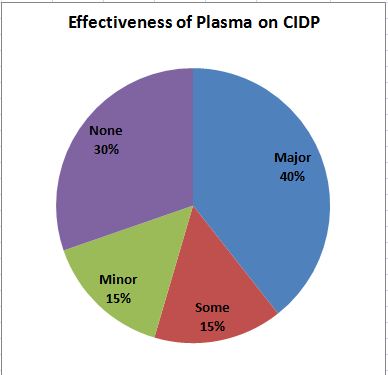
Plasma is much less effective against CIDP than GBS, but it obviously still works for a fair number of people (18 out of 33, just over half).

Immuno-suppressants again have much less effect against CIDP than GBS. though the number it is proscribed for are much higher for CIDP (47) against GBS (10)?

Obviously before deciding on a treatment other factors have to be taken into consideration e.g. potential side effects, ease of administering or availability of the treatments, other health issues..... Which I have not explored and these may have a significant bearing on the results/recommendations above.

From the above data it is easy to see patterns.  What I wonder about is why certain treatments do not work for some patients?  I guess we will never know..... or not from me!  More in a couple of weeks.


Saturday, 6 October 2012

Update 17 - Survey Results Part 4

Again thanks to all those who filled in the survey I have over 410 responses now.  for those who haven't it is:

GBS-CIDP Survey.

The results below are about what was recommended and a start of the different effectiveness of treatments:


What these show is that IVIG is the most recommended treatment, Steroids are recommended to far more to people with CIDP and Immuno-Suppresants far more to people with GBS.  What I find interesting is the number of people who were recommended no treatments, as surely something should be recommended (or is that because like me after my initial attack treatments were discussed, but none recommended, so I didn't have any, but after my relapse either IVIG or Steroids were)?

The average treatments per person is also good indicator, it says to me with GBS at just over 1 once it was diagnosed the treatment recommended was deemed correct (whether it was or not is another discussion).  For CIDP at 2, the doctors were much more uncertain about what to recommend.

Below I look at the treatments generally and what impact they had on the condition:


This graph is of all treatments recommended and their effectiveness.  As you can see the majority were given IVIG and of those most saw a major improvement (I have the individual charts lower down).

The chart relates specifically to the level of improvement seen in having one of the recommended treatments. The was based on a sample of 350 people, as you can see some people must have had more than one treatment.  If I have the capability I may try and graph the number who have had more than one which was the more effective, though I don't think I have enough to sample from yet.

 The next five show the relative effectiveness of each specific treatment:


This clearly shows that IVIG as an overall treatment has been effective for the majority of people and as it was the major treatment recommended I suppose this is justified.Total treated 269 - 49% of sample.

 
What this shows is a complete uncertainty of whether they are good or not, just about all four quadrants are even, so are steroids worth it (especially given the side effects)? Total treated 121 - 22% of sample

Plasma also appears to have significant benefit as a treatment, though not quite as high as for IVIG.  Total treated 75 - 13% of sample.

Immuno-Suppresants, like Steroids, seems to be totally variable in effect.  In fact they appear worse than Steroids for no effect whatsoever. Total treated 59 - 11% of sample.


Other treatments make up the rest (30 people & just 5% of the sample) so the actual results can be swayed by just a few answers.  However some of these other treatments may be beneficial (they range from Pain Killers, to Cancer fighting drugs).

Please remember these are results from a survey aimed to assist people to make a better informed decision, rather than facts about what is advised for the individual.

Next time (in 2 weeks) I will be examining the treatments relating specifically GBS/CIDP and comparing how different treatments are effective or not......


Saturday, 22 September 2012

Update 16 - Survey Results Part 3

On the question of "Where did it start?", the survey said:


It seems quite clear that though the extremities are first to get hit, the majority are for the feet and toes.  What surprises me is that fingers are so high, yet feet beats toes?  I suppose that is because we are all very tactile and when you can't feel with your fingers you know about it very quickly.  Relating that to me, feeling is returning to my legs, but as I never felt with my toes/feet I don't know how much or how quickly as "normal" was not readily known.  Could anyone who has recovery in their fingers comment on this?

Onto the issue of areas affected:


 This has a similar look and feel! (pardon the pun) to the previous one, which I found surprising as I thought the spread would be wider.  The results from GBS or CIDP were quite different:


 What is very noticeable is that a significantly larger proportion of areas was affected for people with CIDP than GBS, yet the actual ratio between areas has similarities.  The biggest variation is actually in the fingers, hands & wrists, where there is a 30% difference between CIDP & GBS.  In fact you could draw the conclusion that GBS rarely affects the upper torso and has a much higher impact on the legs!  Whereas CIDP appears to have a more balanced affect (another pun! - a bit harder to spot?), between the arms and legs.

Out of curiosity I looked at the areas affected between genders:


 Now whilst the areas affected curve for both again looks very similar, what I noticed was in every category of no feeling (red), the male score is higher than the female one.  This can't be coincidence? If you reversed this and looked at not affected (light green) then the difference was even more marked!

Does this mean women are less affected than men? Or they just don't complain as much!!! (I think I've said enough for now).  More in a couple of weeks.


Sunday, 9 September 2012

Update 15 - Survey Results Part 2

I think I made a big mistake right at the start of my survey.  I asked for the age of the people filling the survey in (which is shown in Part 1).  What I should have asked is what was your age when you first contracted the condition (GBS/CIDP)?

So I have done some extrapolation of the date entered, against the age entered, the date the survey was answered and the date when the condition was contracted/diagnosed and I get:


Now if you compare this with the earlier results this changes the age of people contracting GBS/CIDP significantly, so the majority of people were under 45 and very few 65 or over.

Moving onto how the condition was contracted I get some very different results between GBS & CIDP:


What this shows is that significantly more people with GBS thought their condition was due to a virus or other illness and in my view that is because the symptoms occurred much more closely with when GBS was contracted, as CIDP takes a lot longer.  What is also worth noting is that a vaccination is actually deliberately giving you a virus (albeit a "dead" one) so this could be classed as the same.  I know how I contracted CIDP, via a vaccine, but that was easy as it was shortly afterwards that I was laid low by a virus and the rest is below....

The number of doctors/consultants seen was the next question asked.  The results are:


Though a significant number of people did see more than 6 doctors the average number of consultants seen is 3.65 (see below):


What is surprising is that there is minimal difference between any of the categories and I would have expected the consultants seen to be much higher for CIDP than GBS, given the time differential for diagnosis.

The last set of results, are in my view the most interesting so far.  This is based around the question of how fit the person was before contracting GBS/CIDP:


So according to these figures nearly 90% of people were active!  OK so there are bound to be differences in how people marked themselves, but even so this is astounding as I expected this to be more or less even split between the four categories, if not swayed slightly towards passive. I regard myself as fairly passive, though was much more active in earlier years.


Now looking at it for each illness, it seems even more remarkable as clearly CIDP sufferers marked themselves as even more active than GBS, yet the number with GBS who overall were passive is considerably less.

What does this tell us?  One possible interpretation is: If you are more active, then you go to different places and require vaccinations........ Another is that the fitter you are the more healthy you should be, therefore the more active your immune system is....... Or people filled it in wrong?

That is enough to ponder for this part.  I will publish the next set in a couple of weeks and I hope you find them interesting.

Saturday, 25 August 2012

Update 14 - Survey Results Part 1

Thanks go to the 350+ people who have filled in my survey up-until now.  As stated I will publish the results in parts as there are so many and a lot to comment on.  The survey is still available @


All the data is gathered from the survey and I have put into graphical form using Excel, not all people completed the survey (around 82% did and I put a minimum number of questions answered in for the results to be valid).  I have concentrated on differences between GBS & CIDP plus Male & Female, if there other slices people are interested in please contact me:

drew@markhams.me.uk

The first set of results are on the initial number of people and what illness:

This graph shows slightly more women filled in the survey than men, while the numbers for GBS/CIDP were roughly equal (slightly more with CIDP), the data is Female 186 (89 GBS, 89 CIDP), Male 162 (75 GBS, 83 CIDP).  Plus other illnesses (the man ones: 3 x still to be confirmed/diagnosed, 3 x sensory Neuropathy), others didn't state what.

From reading relevant documents it appears that more men have GBS/CIDP than women, so obviously women are more trusting :-)


The age range does more or less tie in with most opinions (I think people are a bit younger than thought), with 60% being 45 or over, I can't comment on pregnant women supposedly more at risk afterwards as I didn't ask that question!
There is also minimal differentiation between the age people contracted GBS or CIDP.

The final set of graphs for this post are about how long to be diagnosed:

These graphs tend to confirm the general opinion about diagnosis.  However the average times are:

GBS: 42 Days,  CIDP: 1004 Days

These are both skewed by a small number of  very large entries, which are either where diagnosis did take very long time or potentially incorrect entries.  What does appear to be certain is that there is significant variation in diagnosis times.

If the longest 10 are removed the averages go down significantly to:

GBS:  10.5 Days, CIDP: 406.8 Days

If you have any questions or comments, then please contact me.  More in a couple of weeks (on Fitness, how it was contracted....).  Sorry too much to publish in one go!

Sunday, 12 August 2012

August 12 - Update 13

Sorry for the delay in posting, but been trying to redo the layout of this blog (as it has become rather large) and have been getting the survey results ready for publishing (hopefully both will be done by the next post - unless the consultants get there first, so watch this space...)


I have just managed to walk half a mile (approx) with the aid of a stick in my local woods.  Really great to be out and manage it, but was absolutely shattered at the end and sweating like a pig!  They say this is supposed to be good for you?  I chose a path that was flat and fairly even, but I had problems picking my feet up properly, especially when I got tired.  I also found put that I now do not walk as quietly as I used to, I saw a rabbit ahead and before I could get quite close without disturbing it, but this time as I saw him, he heard me and was off!

My brother was running a half-marathon yesterday in Sweden (I hope he did OK), my half a mile felt like a half marathon to me.  Still after sitting in the car for a while I was able to drive home.

My daughter graduated in Law from Cardiff:


I am really pleased for her and the hard work she has put in to get to this stage.  Now she has to do the LPC to enable her to become a solicitor, so one more year of effort left.  I managed to get to Cardiff to see the ceremony, which was great.  There was a fair amount of walking/standing which I found very difficult and tiring, but I managed it, in small doses and seats being found/provided at every opportunity.

One curious side issue with being disabled is that parking and access are treated differently throughout the country.  In Cardiff around the University there are no disabled parking space, but parking is free (so you have to fight for a space and hope it is not too far away - we were lucky), yet just abut everywhere else there are marked spaces, close to the facilities.  My local train station is brilliant as on one side you have to pay, but on the other you don't (because the disabled spaces are nowhere near the main parking area (so guess which side you park?)

BTW in a certain chain of Hotels, they no longer have disabled rooms, they are now "Universal Access" rooms!  What a load of baloney! Apparently they have been changed so a not to offend?  It was more offensive to me that they changed them, what a waste of time and money for the company, do I really care what I am labelled (maybe others do)?

Sunday, 1 July 2012

July 1 - Update 12

Back to stuff about me for a bit.....

My physio's have just signed me off their list! Whether that means they have given up on me :-) or they can do no more.....  Seriously I would like to thank them for their positive attitude/persistence and helpfulness over the past 10 months (Maria & Pam).

The tests they have on their sheet are now fairly easy for me, I can even stand on 1 leg for over 15  seconds (and have managed 30 seconds on both legs at home).  The best one is trying to do heal to toe, walking backwards with your eyes closed.  Apparently it removes a lot of the automatic responses from walking as you have never tried to do it before, so your brain/muscles have to work it out manually.  All I know is that it is impossible!  What makes me feel considerably better is having mentioned this to my colleagues at work none of them could do it either - though they were significantly better than me.

I have come on considerably over that period and can do so much more now.  I even go around the house/work without a stick (and am fine on flat surfaces elsewhere).  I went up to London for work with a colleague for the first time in well over a year, on the train.  This was to see how I coped with the London underground, the answer was just!  It was out of rush hour, so quiet and I found the escalators OK, but the stairs were really difficult.  I was glad it was only 200 yards from the station to where we were going, that was me absolutely knackered. After the trip back home, I was totally exhausted, really pleased I had managed it but glad I had tried it with someone with me.

It seems I am confined to the Wii-Fit and the exercise bike (in my lounge) for a while longer, both have been invaluable and I would seriously recommend the Wii-Fit to all people trying to recover from GBS/CIDP as the are a great range of exercises at different levels that help with balance (being able to stand up is a pre-requisite)!  My aim is to do the simple step exercise and get more than 300 points (currently got to 200 - whilst holding onto said exercise bike - I knew it came in useful for something) - not holding on and be able to get the skier down in 27 seconds as he at least finds/sees the gates now!

I can now survive for 8 minutes on the exercise bike (only on an easy setting though) - my aim is to get to 10 minutes by the end of the summer - and still get off under my own steam.  The problem with the bike for me is the lack of scenery as I used to like being outdoors, so I have a bike in the garage that I wheeled out to see if I could get on it and field miserably :-( I can't balance. So maybe next year......

I am still on Predisolone (20mg) every other day, plus Gliclazide (for my diabetes) Alendronic Acid and Vitamin D. They do still give me headaches, but nowhere near as bad as before.  I feel so lucky that I am still improving and getting back towards "normal" whatever that may end up being. Especially as I see on Facebook etc. that other people suffer for years and years, with no/minimal improvement.

"Keep banging the rocks together!"

Saturday, 9 June 2012

June 9 - Update 11

Further developments on the clinical understanding of GBS & CIDP (and how to stop it occurring).....

Once again I have simplified the information gathered to try and make it easily understood, with apologies to any medical people if I have over simplified parts, but if I put the text in verbatim, then no-one would even read my blog!  I have taken my material from multiple sources (wikipedia, journals,web pages) - I can't reference all sources (as this would also make my blog unfit for purpose of passing the base information on).

I have recently found an article on potential methods of stopping auto-immune diseases and their symptoms.  In order to understand the research further medical terminology needs to be explained (and this is the cut down version):

T-Cells can be sub-divided into different categories, one being Treg - Which are regulatory cells that shut down the immune responses after they have destroyed invading cells (thus causing auto-immune diseases). Normally these cells exist with a ratio of less than 1 to 10 (<1:10) to other T-Cells, the proposed solution increases this ratio to over 1 to 1 (>1:1).  One component in the Treg (IL-5 or IL-5r"alpha") seems to promote activation of relevant antigens (IL-4, CD4, CD25, FOXP3 specific Treg) and these cells would control auto-immune inflammation, by stopping the cells going beyond their initial activities of destroying the invading cells.


Interleukin-5 (IL-5) promotes induction of antigen specific
CD4+CD25+T regulatory cells that suppress autoimmunity


Studies, so far, have been performed in a laboratory in New South Wales - Australia.  The figures below have been copied directly from their research papers (the explanations are in English!):


Note: All animals were given a strain similar to GBS.
        White = no other drug, Grey = Sham/placebo drug, Black = IL-5

Figures A, shows the reduced clinical effect on the rats given IL-5 (first graph) and the reduced effect of weight loss (second graph).  The drugs were administered at 5,000 units/day for 10 days from the onset of GBS (usually day 12) and had an effect within 2 days.


Figure B, shows the difference in the thickness/disruption of the myelin sheaths/demyelination between a control sample and those treated with IL-5 using an electromicrograph.  The differences at day 14 & 21 are significant!


Figure C, shows the reduction in percentage demyelination over 14 & 21 days seen in Figure B.

Figure D, shows the use of an IL-5 blocker (Day 13) on the Grey Triangles sample in the figure, that halted the effects of IL-5 and brought the effects back up to the level of who had not had IL-5 administered.

Further tests were performed to see if the improvements seen in rats can be translated to humans.  The initial trials on our blood samples seem positive.  Clinical trials are hoped to be started in the next couple of years.

This is a completely different way of stopping the disease, by increasing the number of "good cells" that would prohibit the attack rather than directly going against the cells causing the issue.

This treatment could also impact other diseases such as MS. To me the results look very promising.


Saturday, 26 May 2012

May 26 - Update 10

STOP PRESS: I now have over 300 completed responses to my survey - Thank You to one and all.  I will be producing more results in July/August, they will be in a separate blog.

.......Following on from the previous

There are different cells in your body for different purposes for the immune system, two main ones seem to be relevant:

  • B-Cells - they are the military intelligence, that finds issues/invading antigen
  • T-Cells - these are the soldiers that actually destroy the target, also known as killer cells

Vaccinations - Do they have a part to play in this?

The simple answer is Yes and No! (Hang on I'm starting to sound like a doctor?)

OK - There have been a number of studies into viruses, the vaccinations and their affects for increasing the risk of certain diseases (including GBS).  What is a vaccine?

vaccine is a biological preparation that improves immunity to a particular disease. A vaccine typically contains an agent that resembles a disease-causing microorganism, and is often made from weakened or killed forms of the microbe, its toxins or one of its surface proteins. The agent stimulates the body's immune system to recognize the agent as foreign, destroy it, and "remember" it, so that the immune system can more easily recognize and destroy any of these microorganisms that it later encounters. - Thanks Wikipedia

Thus it is possible to assume that as this is actually a virus/bacteria that is being deliberately introduced into your system and causes the cells above to recognise the danger and so re-act/remember, it could be responsible for causing GBS?

Well Yes and No! (see above)

In 1976 there was a vaccine developed for a swine flu like virus (in the US), that appeared to increase the risk of GBS and this vaccine was terminated.  They did prove that people who were given the vaccine did have an increased risk (roughly two to five times - depending on who's research you read).  Studies from 2000 onwards indicate there is no/minimal links between vaccinations and the rate of infection per se.  In fact the H1N1 incidence in 2009 actually happened part way through a study in Paris into GBS and causes and they found no increased risk due to taking the vaccination.  On top of this, there was a study of 50 million vaccinated people in 5 European countries in 2009 that found 104 cases of GBS, thus the researches could find no link.

So based on these fact the actual normal rate across these 5 European countries is 2.08 per million - significantly different to what was stated in my last post?

As it is the introduction of foreign bodies into your system, then (like in my case - as I had inoculations in January and 2 weeks later had flu like symptoms) there is bound to be some chance, but....... (BTW for my wife's 50th birthday we are going on a cruise to the eastern Med - as long as I am fit enough - one burning question is "Should I have the vaccinations????").  So I have a seriously vested interest in saying "YES!" they do play a part, but I can't find proof that satisfies me!

Anyway.....

Your immune system knows about internal and external cells, but in order to attack your internal ones, it must get very confused? Again there are theories and this does happen in a number of other diseases.

The one thing I do not understand is "Why me?".  What I mean is if there are 1 in 10,000 of me getting this condition from a virus/bacteria/vaccine then why was I the one?  There must be something different in me that triggered this that the other 9,999 don't have.  This is also what the doctors/professionals don't know, unfortunately.  There is research going on and I will try and comprehend where they have got to, but I am still digging.

Sunday, 13 May 2012

May 12 - Update 9

GBSSG (UK) Notes - Part 2

This is starting to get complicated (for the ordinary person)!  I have been researching the findings from the meeting and am trying to understand/correlate all the information.  In my travels, on the web, I have come across some wonderful medical terms, one wins (so far):

monosialotetrahexosylganglioside

This is commonly known as GM1 (may as well be called "Bob" for all I cared!).  The relevance is that people with GBS have higher levels of anti-GM1 antibodies and this can interfere with motor neuron function, other antibodies can be relevant depending on the specific strain/type of GBS (e.g. GD3, GD1a, GQ1b - Miller-Fisher).

Please note I am using the term GBS to encompass all the different types (CIDP, AMAN...)

There are a number of interesting "facts" that have come out of my research (not just from the support meeting):

1) Now Polio has largely been eradicated; GBS is the most common neurological disease in the world (Do strokes count?)
2) About 1,500 cases of GBS occur in the UK each year
3) The worldwide rate is approx 1.3 per 100,000 people annually
4) The likelihood of women getting GBS decreases during pregnancy, but increases in the few months afterwards
5) Around 20% of patents have residual neural issues
6) Approximately 5-10% of people die, usually from respiratory complications
7) The amount of research into the "big 5" diseases is astronomical compared with GBS (no surprises there!)

How do you get GBS?

There appear to be a number of different ways of contracting GBS:

A) From bacteria in foods, the most likely source appears to be Campylobacter Jenjuni - which sort of gives you food poisoning.  Then 1 to 3 weeks later a small number of patients get GBS (between 1:1,000 to 1:10,000 roughly)

B) Flu like viruses (e.g. A/H1N1) or general influenza - again you get the virus and a few weeks later you can contract GBS (in similar ratio to above)

C) Epstien-Barr Virus (EBV - the Barr has no relation to Barre in GBS!) a member of the herpesvirus family signs are sore throats and swollen lymph glands (ditto for ratio's)

It is also possible to get GBS from HIV and other infections of this type.

According to the research I have found the numbers stack up roughly 40% from Campylobacter, 20% from Influenza like illnesses, 10% from EBV.  Again I am not a medical "expert" and all these findings are taken from journals and papers/web pages I have visited and taken information from.  You could state they are inacurate, but are my best guess on what I have found.

What seems to be similar is what happens to cause GBS, but first I had to understand the immune system, so here goes:

The body creates antibodies to attack the antigens (antibody generators) in an invading cell, these are like a lock and a key see below:


When an infection is found millions are produced (as opposed to the few "sentries" wondering around in normal times), these then attack the invading cells and neutralise it's effects.  After a time the immune system stops producing these and things return to normal.

So in order to combat the illnesses listed above, the immune system creates antibodies that match the patterns and they then attack the bacteria and wipe it out, now it appears that sometimes these bacteria can be very similar in pattern to antigens of the nervous system, so the immune systems keeps sending out antibodies to attack these as well, so the sheath and axon etc are damaged/destroyed.

Interesting fact: antibodies belong to the family of large molecules called immunoglobulins - hence the IVIG!

I am now going for a long lie down, to allow my brain to recover from this terminology overload, once again I apologise to any medical personnel who think I may have over-simplified things, but I am trying to get this down to a easily understood level and the medical journals etc use far too many long words for "normal" people. 

More later..... 

Sunday, 29 April 2012

April 29 - Update 8

Information From the GBSSG (UK) Annual Meeting - Part 1

I am attempting to summarise what I found out at the meeting, this is a laymans approach, so apologies to medical professionals and if this is already known, but I decided to start at the beginning:


In your body there is a central nervous system, that is in your spinal chord and up to your brain and a peripheral nervous system,  these run from the spinal cord along your arms and down your legs.  Above is a picture of a normal peripheral nerve.  Signals are sent up and down these pathways, when things are normal.

Below is my simplistic representation of the relevant parts of the peripheral nerve to GBS/CIDP:

The nerve is very much like a wire conducting signals within.  It can't operate without the central cable (axon) or the outer coating (Myelin sheath).  Some of these "wires" can be very long, in the worst case over 1 metre from the base of your spine to your toes, in my case and even longer if you are taller!

There appear to be three different potential issues:


The first is the Myelin sheath is attacked and damaged, hence the signals get disrupted and either take longer to get there in most cases, or fail to get there at all.  Now the Myelin can repair itself and does over time, but repeated damage can cause more severe issues and thus disrupt the signal even more.  This, in my opinion, seems to be, by far, the most common.  The nerve conduction tests are run to confirm this issue.


The second is the actual Axon is broken/snapped, generally at one end or the other, it is believed.  The problem here is that if the axon is broken at the far/bottom end it does not take long to regrow and recover, however if it is broken at the top end the time to re-grow will be considerable (for 1 metre they estimate 3 years!)


The third is when the nerve path is actually blocked.  This is where something has inserted itself in between the nerve path and actually halted the connection totally.  In order to resume the connection the blockage has to be removed completely, but he use of various drugs etc.

I will put more information up from the meeting next week (or so) about how you contract the disease in the first place, as I am still waiting confirmation on usage of certain slides.  I again apologise for potentially over-simplifying the subject, but I have tried very hard to avoid complex terms and medical jargon.

My Progress

The DWP have made a decision and awarded me some allowances, this means the car changes have been paid for (and they have back dated them by nearly six months) - I may even get a new car :-).  I have to be re-assessed in 18 months, but they got there in the end!  I just hope others do not face the struggle I have had - but have a feeling they do at least in the UK!

I spent nearly 2 hours on Wednesday having numerous breathing tests/scans etc, in a brand new device (cubicle) that measures just about everything to do with lung capacity and how you breath.  This machine has a mouthpiece like in scuba equipment and they put a clip on your nose, forcing you to breath through your mouth.  The tests were complex and I suppose thorough, what I learnt was your lung capacity is related to your height - the taller you are the greater the capacity.  My capacity is 108% of what is expected - so that is good!

The other good news is (baring some blood tests) my Sarcoidosis is in remission YES!!!!  The reason for the baring blood tests is they were supposed to be performed on Wednesday after the other tests, but the nurse was not sure how fresh the blood needed to be for the tests, so told me to come back another day - and I have been too busy to do so, trying to get back to work!  I have to go back in three months to have further tests.