OK - so I had to fill in their new form to our Department of Work & Pensions (DWP) to see if I qualify for any benefits again (commencing the end of November 2013). All 39 pages!
The fun part is that as the UK has severe austerity measures in place they have changed the criteria for being able to qualify for benefits for being disabled in really significant ways! (I hope this is not happening in your countries). There is also more of a points system and you have to get a certain number of points across the form to qualify otherwise you do not. This means that even people in wheelchairs may not qualify for the benefits and I find that disgraceful.
One example is that they said on the previous form could you walk 50 metres, how long and how easy/difficult, they now use 20 metres as the criteria!
It is also even more of knowing how to fill in the form and what to say, as they are looking for key words and phrases to score the highest marks on a question. SO anyone who is filling these in, do not be proud, go to the citizens advice bureau (CAB) or at the very least get professional advice/assistance. I have being doing an exercise program specifically designed for my by a physiotherapist who knows about CIDP (Yes!!!!) and I asked her advice - but more about that in my next post.
I filled in the form around the beginning of August, as best that I could and sent it back. Before I sent it I scanned it in, bearing in mind my last episode with the DWP, where they lost my forms and I had to get my MP involved, before they would even admit to loosing it!
I do not expect to get the carers allowance anymore as though there are some tasks at home I still find difficult to do (e.g. lifting a heavy pan and moving at the same time) most of it is manageable as I have adapted how I do things. Plus I have family around to assist.
I phoned them up mid way through September, to be told they didn't seem to have received my form! (oh no not again). I then asked for an email address so I could send the saved copy to. Now comes my mistake, I had saved the 39 pages as a PDF (Adobe Acrobat read only format, so it couldn't be changed and was dated when I filled it in), even worse a colour PDF! This meant when I cam e to send it in, it was 21.5MB in size. Anyway I sent if to this email address and received nothing back. So I phoned the next week and was told they would have sent a reply if they had seen it. So I uploaded it to the Internet and sent a copy of the link to them so they could download it - but they could not do that either! Oh and why was I using that email address as it was the wrong one...... (I could have screamed).
Any way I am now talking to a very nice lady (I could put her name in here, but incase she reads it I don't want to embarrass her or get her into trouble) from the DWP in Bristol who has given me the right email address and I have tried sending it again, but it is too large and she tried to get the limit increased but their IT function won't allow this, she can't connect to the Internet to pick it up (as her IT function won't allow it!), she has sent me a fax number, but I don't have fax capabilities without printing it off.......
So I have just completed printing it and have asked for confirmation of the address to send it to and maybe a very large envelope!
More in a while.
Saturday, 5 October 2013

Sunday, 8 September 2013
Update 31 - Information on CIDP (Part 3)
....continuing from previous blog posts....
In 2009 a supposedly definitive list for qualifying for CIDP was produced (by statisticians and leading Neurologists in the US). The simplified version is:
Patients with symptoms for over 8 weeks would be classed as CIDP if:
AND EITHER
OR
However these are not seen as relevant by the majority of NEUROLOGISTS!
Dr Barohn states his recommended 1st line treatments are Prednisone or IVIG and if they do not respond then switch to the other (say after a couple of months). Roughly 50% respond to the first and 50% respond to the second, so 75% overall. If they are already in the hospital then Plasma is a much easier option as this makes it much easier to administer.
Other potential treatments mentioned (copyright names in brackets):
SubCutaneous IVIG (SCIG) - new development of IVIG trials being run now.
Improvements are seen first in the muscles nearer to the core (hips, shoulders) before the ones further away (feet, fingers).
1975 2007
Mortality: 11% 3.1%
Working with Disability: 60% 63%
Not Working: 8%
Wheelchair bound: 28% 7%
Recovered: 4% 31.1% (however with treatment)
Aids to Walk: 28%
The likelyhood of patients ever fully recovering is very low, less than 10%. Most people will never recover fully and to tell them so is completely misleading. Strength will be much better - hopefully, but there will be weakness remaining.
In 2009 a supposedly definitive list for qualifying for CIDP was produced (by statisticians and leading Neurologists in the US). The simplified version is:
Patients with symptoms for over 8 weeks would be classed as CIDP if:
- No genetic abnormality
- No other substances introduced for other issues
AND EITHER
- 75% of nerve tests had a response with over 50% of these showing an issue
OR
- Symmetric weakness in all four limbs and weakness in at least one of the hips and shoulders
However these are not seen as relevant by the majority of NEUROLOGISTS!
Treatments
The only treatments that are proven (clinically in a randomised control trial - RCT) to work on CIDP are:- Prednisone (Steroids) - 40 to 95% of patients respond positively, after 2 months of usage is the peak benefit. There is a 30% chance of remission.
- Plasma Exchange - similar responses to Steroids - the main issue is access (thus not the first line therapy)
- IVIG - much later process, though the initial trials were much shorter - 6 weeks. Around 40-50% respond. Later trials showed similar numbers made an improvement (on arms and legs) at 47.5%, though in the same trials 22.5% who had placebo improved which means you get better anyway. But they still don't know how it works!
Dr Barohn states his recommended 1st line treatments are Prednisone or IVIG and if they do not respond then switch to the other (say after a couple of months). Roughly 50% respond to the first and 50% respond to the second, so 75% overall. If they are already in the hospital then Plasma is a much easier option as this makes it much easier to administer.
Other potential treatments mentioned (copyright names in brackets):
- Mycophenolate (Cellcept) - Not proven
- Interferon (Avonex) - trials negative
- Etanercept (Enbrel) - not proven
- Rituximab (Rituxan) - not impressed in neuropahy, not seen much response
- Alemtuzumab (Campath) - too toxic!
SubCutaneous IVIG (SCIG) - new development of IVIG trials being run now.
Improvements are seen first in the muscles nearer to the core (hips, shoulders) before the ones further away (feet, fingers).
CIDP Prognosis
In 1975 (P J Dyck) created a set of stats and this was reviewed in 2007:1975 2007
Mortality: 11% 3.1%
Working with Disability: 60% 63%
Not Working: 8%
Wheelchair bound: 28% 7%
Recovered: 4% 31.1% (however with treatment)
Aids to Walk: 28%
CIDP Caveats
- Don't undertreat (IVIG especially - min 2 to 3 months)
- Don't overtreat (Steroids really nasty side effects)
- Don't expect too much from the treatments
- Change treatments if it doesn't work
The likelyhood of patients ever fully recovering is very low, less than 10%. Most people will never recover fully and to tell them so is completely misleading. Strength will be much better - hopefully, but there will be weakness remaining.
Saturday, 24 August 2013
Update 30 - Information on CIDP (Part 2)
Further information from the video on CIDP......
Nerve biopsies are not useful for detecting CIDP - a lot of places can't process them properly (in the US? - bar Huston and a couple of others) and the information can be conflicting as there is no definite outcome. Also the I stands for inflammation and there is not always inflammation shown in the nerve biopsy (maybe the disease needs renaming?)
CSF examinations (lumbar punctures) show high levels of proteins in 80-90% of cases, however if the other symptoms were there then even with levels at 40 - 50 this would still be CIDP.
Diabetics having CIDP appears more common and the reasons are that Diabetes is a Neuropathy (but without the weakness) and it is possible for the nerve conduction values to creep into the range for CIDP.
The doctor states that: "In his opinion a reasonable number of diabetics get incorrectly diagnosed with CIDP!"
As the weakness can be there for any other reason and the first 2 or 3 seconds of the tests prove how much weakness they have, so after the first couple of seconds if it becomes easier to push against their movement this doesn't count.
Diabetic patients are the toughest cases to sort out - there must be definite symptoms in all other areas. As they will usually have numbness in their feet. The doctor said he would expect significant weakness in the arms as one of the key differentiators.
One of the doctors attending stated he uses 5 points and if the patient has 3 out of 5 then it is CIDP:
With diabetics this must be much higher! As they can have a number of the above.
Below is the chart shown in diagnosing CIDP:

And this is my version:

The actual terminology used is terrible for the normal person, so I apologise for this. However the doctor did state that getting hung up specifically on these criteria is not helpful to the potential patient.
I do have diabetes. So by this scale I don't have CIDP? As there was no issues with my arms ever - they were and are 100% OK! However I did tick all the other boxes. Unfortunately for me I did and do have CIDP, so the CSF, EMG and complete lack of reflexes in my legs proved this.
More later...
Nerve biopsies are not useful for detecting CIDP - a lot of places can't process them properly (in the US? - bar Huston and a couple of others) and the information can be conflicting as there is no definite outcome. Also the I stands for inflammation and there is not always inflammation shown in the nerve biopsy (maybe the disease needs renaming?)
CSF examinations (lumbar punctures) show high levels of proteins in 80-90% of cases, however if the other symptoms were there then even with levels at 40 - 50 this would still be CIDP.
Diabetics having CIDP appears more common and the reasons are that Diabetes is a Neuropathy (but without the weakness) and it is possible for the nerve conduction values to creep into the range for CIDP.
The doctor states that: "In his opinion a reasonable number of diabetics get incorrectly diagnosed with CIDP!"
As the weakness can be there for any other reason and the first 2 or 3 seconds of the tests prove how much weakness they have, so after the first couple of seconds if it becomes easier to push against their movement this doesn't count.
Diabetic patients are the toughest cases to sort out - there must be definite symptoms in all other areas. As they will usually have numbness in their feet. The doctor said he would expect significant weakness in the arms as one of the key differentiators.
One of the doctors attending stated he uses 5 points and if the patient has 3 out of 5 then it is CIDP:
- Progressive course - it is getting worse slowly
- Symmetrical proximal weakness
- Loss of reflex - also EMG's
- High CSF Proteins
- Demylinating Features
With diabetics this must be much higher! As they can have a number of the above.
Below is the chart shown in diagnosing CIDP:

And this is my version:

The actual terminology used is terrible for the normal person, so I apologise for this. However the doctor did state that getting hung up specifically on these criteria is not helpful to the potential patient.
I do have diabetes. So by this scale I don't have CIDP? As there was no issues with my arms ever - they were and are 100% OK! However I did tick all the other boxes. Unfortunately for me I did and do have CIDP, so the CSF, EMG and complete lack of reflexes in my legs proved this.
More later...
Saturday, 27 July 2013
Update 29 - Information on CIDP (Part 1)
I have recently found a video specifically about CIDP, from an expert in this field:
Below is a synopsis of the first part of this hour long video, presented in November 2012, to a audience of medical experts. It has taken me around 3 hours to de-crypt some of the terms and slides used (so far).
Apologies if I have made this too technical, but I have tried my best to make it understandable.
If you want to watch the full version it is available @ http://www.gbs-cidp.org
A: Symmetric proximal and distal weakness with sensory loss
Explanation: Muscle weakness away from the core of the body (i.e. in the arms &/or legs) with loss of feeling within those same limbs. The weakness & loss of feeling being the same down both sides of the body (left and right)
If you just have loss of feeling - this can be caused by other issues (e.g. Diabetes)
If it is not the same on both sides, these are other conditions linked to CIDP/GBS.
A: Nerve conduction studies (NCS)
Explanation: There are two types of nerves Motor (control movement) and sensory (control feeling). Both can be tested to see how fast they react to an electrical stimulation. This measures the speed it takes for the signals to get from the one place to another (latency measured in milliseconds) and is performed in a hospital or clinic.
Though a Lumbar Puncture can also be used (CerebroSpinal Fluid - CSF, or Spinal Tap), this measures the levels of proteins found in the spine and is another good indicator of CIDP if they are high, the presentation states that this backs up the NCS findings

Explanation (I hope!):
NCV - Nerve Conduction Value (metres per second)
DL - Distal Latency (signal travel time between 2 points)
F Waves - time for signal to travel back to central nervous system
LLN - Lower Limit of Normal (you've got to love them!)
ULN - Upper Limit of Normal
Location of Nerves:


So for each of the different nerves in the arm, the NCV needs to be less that 33.6 metres/second (<70%) for them to be fairly certain it is CIDP, with the norm being 48. In the legs this is 29.4 against 42.
For the Median nerve in the arm the time needs to be over 6.7 milliseconds (>150%) against the norm of 4.5 and the Ulnar is 5.4 to 3.6 (why these are different I don't know - I presume they have to be different lengths). In the legs they are the same at 9.9 against 6.6 milliseconds.
The Time for the signal to travel back to the central nervous system is different for all @ Median: 46.5 to 31, Ulnar: 48 to 32, Peroneal: 84 to 56 and Tibial 87 to 58.
I am now going for a lie down to recover and will put more on this presentation up later!!
Richard J. Barohn, M.D. - Chair, Dept. of Neurology, University of Kansas Medical Centre
Below is a synopsis of the first part of this hour long video, presented in November 2012, to a audience of medical experts. It has taken me around 3 hours to de-crypt some of the terms and slides used (so far).
Apologies if I have made this too technical, but I have tried my best to make it understandable.
If you want to watch the full version it is available @ http://www.gbs-cidp.org
What is CIDP
Q: What pattern of Neuropathy specifically defines a sufferer from CIDP?A: Symmetric proximal and distal weakness with sensory loss
Explanation: Muscle weakness away from the core of the body (i.e. in the arms &/or legs) with loss of feeling within those same limbs. The weakness & loss of feeling being the same down both sides of the body (left and right)
If you just have loss of feeling - this can be caused by other issues (e.g. Diabetes)
If it is not the same on both sides, these are other conditions linked to CIDP/GBS.
How to prove it is CIDP
Q: What is the best test for CIDP?A: Nerve conduction studies (NCS)
Explanation: There are two types of nerves Motor (control movement) and sensory (control feeling). Both can be tested to see how fast they react to an electrical stimulation. This measures the speed it takes for the signals to get from the one place to another (latency measured in milliseconds) and is performed in a hospital or clinic.
Though a Lumbar Puncture can also be used (CerebroSpinal Fluid - CSF, or Spinal Tap), this measures the levels of proteins found in the spine and is another good indicator of CIDP if they are high, the presentation states that this backs up the NCS findings
What NCS Values point to CIDP?
Below is a table taken from one of the slides which just proves how complex and difficult medical people seem to want to make it for the ordinary person in the world to understand what they are saying!
Explanation (I hope!):
NCV - Nerve Conduction Value (metres per second)
DL - Distal Latency (signal travel time between 2 points)
F Waves - time for signal to travel back to central nervous system
LLN - Lower Limit of Normal (you've got to love them!)
ULN - Upper Limit of Normal
Location of Nerves:


So for each of the different nerves in the arm, the NCV needs to be less that 33.6 metres/second (<70%) for them to be fairly certain it is CIDP, with the norm being 48. In the legs this is 29.4 against 42.
For the Median nerve in the arm the time needs to be over 6.7 milliseconds (>150%) against the norm of 4.5 and the Ulnar is 5.4 to 3.6 (why these are different I don't know - I presume they have to be different lengths). In the legs they are the same at 9.9 against 6.6 milliseconds.
The Time for the signal to travel back to the central nervous system is different for all @ Median: 46.5 to 31, Ulnar: 48 to 32, Peroneal: 84 to 56 and Tibial 87 to 58.
I am now going for a lie down to recover and will put more on this presentation up later!!
Sunday, 30 June 2013
Update 28 - Down to Earth
Survey Delivery
So I delivered my survey results and it didn't go too well for a number of reasons:- I was put on last so the people I wanted to talk to about my findings, the doctors and professionals were no longer around. I did not want to be put on last as I know this is the worst slot.
- I was given a radio mike (which in years of presenting I have never used/required) which failed to pick up my voice every-time I turned my head to point/look at my slides, so after the third slide I took it off.
- A number of the questions afterwards on why people didn't know about the survey and me saying it was because groups like the GBSSG couldn't/wouldn't advertise (never mind support me) was to blame, this was consistent around the world
I was not at all happy about my performance or the circumstances. My opinion of the GBSSG (UK) is that they are very closed/cliquey and someone like me doesn't really fit in, so I am unlikely to go to another meeting (I tried!).
I did get a very interesting response to a series of posts at the event, whereby the general feeling is that people who attend these events have a very negative opinion of life and the diseases, the point was made these people still have issues and the majority who have got better are now getting on with their lives.
My Life
I am still slowly recovering... I am now off the Steroids completely and will see what impact/effect this has on me, but I was down to such a minimal dosage (10mg - from the original 60) anyway it shouldn't be too bad. I just took a whole load of pills back to the pharmacist to dispose of (around 9 boxes of 5 different types). So I am left with just Metformin and Glyclazide for the diabetes, so at last this should be stable - Yippee!Still feel tremendously tired and working is very hard, somehow I don't think I will ever solve this riddle. My doctor told me to have naps during the day but this just doesn't work/tie in with work, so I feel shattered at the end of each day and the weekends are just for recovery. I suppose I am lucky to be able to get back to work.
I have just signed up for an exercise survey for GBS/CIDP and neuropathy related issues, and had a visit by a Physio who knows about these conditions and so understands the issues. She has given me a 12 week list of exercises to do 3 times a week, they may sound simple to people with no issues but all are "fun" for me.
- Stand on tiptoes and down 10 times slowly (I have to hang on to something)! Then flex my foot
- Slide down a door (bending my knees) and up again 10 times
- Lifting my knees (doing a clam) whilst lying down 10 times
Then I need to be on the exercise bike for 20 minutes of gentle cycling - this really tires me out and I should do this one 5 times a week. So far so good, but it does depend on where I am working if I can do them all the time.
I will be publishing my results of the full survey sometime, just trying to acquire the latest version of MS Office, so I don't have to manually re-paste them all.
Will keep you posted.
Sunday, 14 April 2013
Update 27 - Progress or Not
Where I am @
We went on holiday for a week and though it was great and I could get out, I have real frustration about how little I can do without causing severe issues with my health. It seems like 2 steps forward and 3 back. I am back to my original weight though in all the wrong places and in order to combat this I shouldn't do much exercise... It seems like a continual spiral to me.
We went for a walk around part of an Island call Sark, just of the French coast, it was great to be out and the scenery and weather were brilliant. It was a real shame that I suffered so badly afterwards, as it is just the type of exercise I like doing.
The picture of me (and my daughter) is with a stick on Sark and boy did I need it!

I suppose the good news was no wheelchair :-)
Presentation of Findings
I am presenting my survey findings to the UK GBS Support Group on Saturday 20th of April in Liverpool. This is a good opportunity to tell more people of my findings, I do wonder how many of the medical profession will take me seriously! I also feel like making a statement about the 516 people who completed the survey for me, with absolutely no assistance at all from any of the recognised support groups. Just think how many I would have got if they had bothered even to suggest to their members that this may be of interest! I am going to give it my best shot and maybe some of my findings will make them think, at least a little bit.I still have many more responses than any "official" survey and the results are worth something to me.
A large number of people have corresponded with me to pass comments and say thanks. That, has totally vindicated all the effort.
Wish me luck!
Saturday, 2 March 2013
Update 26 - Survey Conclusions
My survey into GBS & CIDP will stop running in 1 week (on the 10th of March 2013). Please can anyone with GBS/CIDP who reads this and hasn't filled it in, do so. I have around 500 completed results and would like as many more as possible. The link is:
http://gbs-cidp.questionpro.com
Conclusions
As I am not a medical person and the sole "experience" of GBS/CIDP is based on what has happened to me. What I conclude below is based purely on how people have responded to my survey and the feedback I have been given to the results:
- The age range of people contracting GBS/CIDP is around 35 to 64 - which is lower than generally assumed (this could be countered by the fact that younger people use computers therefore are more likely to fill in something on-line)
- The actual fitness levels of the people who get GBS/CIDP have nearly 90% as active or fairly active. Is this because they have more active immune systems? or because they travel more and expose themselves to more hostile/less sterile environments? or have more injections.....
- It is definitely the extremities that are mostly affected, with the feet being slightly ahead of the hands. However CIDP has a higher affected area all over the body than GBS (more areas affected by around 20%)
- IVIG is the most proscribed treatment and seems to have a reasonable success rate, plasma is an alternative in some countries and steroids are more effective against CIDP than GBS, but all treatments have a fair degree of uncertainty about whether they will work at all and there is no miracle cure!
- Men seem to complain less than women (that is a generalism about illness and going to doctors anyway). However women seem to get on with things and cope with pain better!
- A high number of people with GBS are still stating they have after effects/major issues. The areas this has shown up in are getting around, nerve pain, how healthy are they now and ability to work. So if GBS is acute and a one hit illness, people should be able to return to a reasonably normal life afterwards? It is commonly stated that 80% of people make a full recovery from GBS and 20% from CIDP. Whilst the results certainly back up the latter, there seems to be a lot less people making anywhere near a full recovery from GBS and as for being acute (it is certainly not "a cute" condition!), a significant number appear to be having long term residual effects. I would suggest that the boundaries and differentials put in place between GBS & CIDP need re-examining and that the leas than 4 weeks - GBS; over 8 weeks - CIDP is not as accurate as the medical people think and there is always the people in between......
The final conclusion is that there needs to be more research and understanding, however, I hope, at least more is known from a patients eye view now than before.
Presentation
The GBS Support Group in the UK have an annual meeting, this time near Liverpool on the 20th of April 2013. I have been given a 20 minute slot to present some of the results from my survey (as I don't have time to do them all) and then answer questions. The presentation will be based on the final survey number, around 500. I will happily send the final version to anyone (after the 20th of April) who may want a copy, so please email or facebook me.
I hope the presentation will be illuminating & interesting and I will represent the findings in a fair and accurate manner. I will also put in a number of the conclusions from above and try and get the opinions of the medical people at the meeting to my results.
Thank You
I would like to say a great big thank you to all the people who filled in my survey and have made it into the successful venture it has become. When I started out on this I had no idea how it would be received and what would come out. I wish I had phrased some of the questions better and maybe asked others, but I hope that publishing real information based on our experiences, this has assisted people in understanding how others are affected and provided some insights into the nature of GBS/CIDP.
It was a shame that, apart from minor curiosity from certain medical people and individual support from one or two sections of the GBS/CIDP community, not one of the formal groups actually assisted me in any way or even sanctioned that what I was doing. Yet thanks for your efforts and support.
Now all I have to do is publish the results to the web for the 500!.....
Saturday, 23 February 2013
Update 25 - Survey Results Part 12
This is the last part of the original survey, based on the 300 from August 2012:
I asked about the ability of people to return to work:

To my untrained eye this looked a bit wrong, so separating GBS & CIDP you get:


Now this really did not make sense. If GBS is an acute condition and 80% of people with it make a good recovery, then I would expect 80% of those to be back at work (so I expected a 20% - No, 20% - Limited and 60% - Fully), whereas for GBS we have a 50/50 split. So, whilst I am happy with the CIDP figures, the GBS ones seem to be far too high, is it because:
I do not know the answer. From my position, with CIDP, I have returned to work fully (with modifications to my car and job), but I suffer massively from fatigue and can (and have) over do it and cause issues, but as I need to earn money, I have little choice.
Looking at how healthy people now are, we get:

What we can clearly see is that GBS sufferers are much more healthy than those with CIDP, as stated before this is entirely expected. Once again though, I would have presumed the numbers for GBS would be substantially higher?
The final chart shows this direct comparison off better:

So people with GBS are healthier than people with CIDP, but the difference from the people who filled in my survey is not that distinct.
These are my last charts. On my next submission I will try and draw some conclusions, then I have to re-incorporate the 500 results (ish) I now have and work out how to display the results in an easier form for you to digest (and one that won't take me 6 months to publish!).
I asked about the ability of people to return to work:

To my untrained eye this looked a bit wrong, so separating GBS & CIDP you get:


Now this really did not make sense. If GBS is an acute condition and 80% of people with it make a good recovery, then I would expect 80% of those to be back at work (so I expected a 20% - No, 20% - Limited and 60% - Fully), whereas for GBS we have a 50/50 split. So, whilst I am happy with the CIDP figures, the GBS ones seem to be far too high, is it because:
- I asked the question in the wrong way? "Are you able to return to work? (Yes - Fully, Yes - Limited or No)"
- Are people being mis-diagnosed with GBS when they have CIDP (because GBS is more known about?)
- Does it relate to previous slides about fatigue and this causes them not to be able to return to work
- Are the previous thoughts on this for GBS wrong
- Should other factors be considered:
- like people are older and recover less fast
- were much fitter before so will struggle afterwards
- generally in the before and after they can do less
- Is GBS not an acute condition!
I do not know the answer. From my position, with CIDP, I have returned to work fully (with modifications to my car and job), but I suffer massively from fatigue and can (and have) over do it and cause issues, but as I need to earn money, I have little choice.
Looking at how healthy people now are, we get:
What we can clearly see is that GBS sufferers are much more healthy than those with CIDP, as stated before this is entirely expected. Once again though, I would have presumed the numbers for GBS would be substantially higher?
So people with GBS are healthier than people with CIDP, but the difference from the people who filled in my survey is not that distinct.
These are my last charts. On my next submission I will try and draw some conclusions, then I have to re-incorporate the 500 results (ish) I now have and work out how to display the results in an easier form for you to digest (and one that won't take me 6 months to publish!).
Saturday, 9 February 2013
Update 24 - Survey Results Part 11
This is the penultimate set of results of my survey (based on the 300 completed originally). These are about where nerve pain is and how tired people get:

This graph tends to follow the trend of all the other "feelings" charts, whereby the extremities are most affected with the feet/toes being marginally ahead of the hands and fingers. I presume the toes are slightly less than the feet because, unlike the fingers which are the most used parts of the body, the toes are not used - well that certainly applies to me (no pencil picking up ever again!). We all know immediately if our fingers have issues.

By comparing GBS & CIDP the relationships between the areas is more or less the same, but the numbers are higher with CIDP, which is to be expected, as people (me included) still get pain.

Comparing men and women, as with other charts, seems to bear out the theory that men complain less? Though why is it the one area that men complained more was around the stomach?? (must be to do with food!)
This next part is concerned with how tired people get:

As you can see the vast majority do! From a statistical viewpoint, noting the age of the people filling in the survey, would they not be getting more tired anyway? Maybe I should look into this more closely??
From a GBS versus CIDP viewpoint:


It is clear there is a difference and as a person with CIDP, I can agree that I am exhausted at the end of each and every day - and really don't know where the energy has gone - when comparing myself to before the illness .
My follow on question to the GBS sufferers (and I suppose to CIDP as well) is "Is the pain and tiredness still there?"

This graph tends to follow the trend of all the other "feelings" charts, whereby the extremities are most affected with the feet/toes being marginally ahead of the hands and fingers. I presume the toes are slightly less than the feet because, unlike the fingers which are the most used parts of the body, the toes are not used - well that certainly applies to me (no pencil picking up ever again!). We all know immediately if our fingers have issues.

By comparing GBS & CIDP the relationships between the areas is more or less the same, but the numbers are higher with CIDP, which is to be expected, as people (me included) still get pain.

Comparing men and women, as with other charts, seems to bear out the theory that men complain less? Though why is it the one area that men complained more was around the stomach?? (must be to do with food!)
This next part is concerned with how tired people get:
As you can see the vast majority do! From a statistical viewpoint, noting the age of the people filling in the survey, would they not be getting more tired anyway? Maybe I should look into this more closely??
From a GBS versus CIDP viewpoint:
It is clear there is a difference and as a person with CIDP, I can agree that I am exhausted at the end of each and every day - and really don't know where the energy has gone - when comparing myself to before the illness .
My follow on question to the GBS sufferers (and I suppose to CIDP as well) is "Is the pain and tiredness still there?"
Saturday, 19 January 2013
Update 23 - Survey Results Part 10
This part starts looking at nerve pain. The following graphs are for whether people have nerve pain and whether they regard it as mild or severe.

The overall graph look quite balanced between the three categories, with Mild being the highest (marginally).


When you start looking at the differences between GBS & CIDP, they are significant. With Severe increasing and None decreasing. It is interesting that Mild stays more or less the same.


When you get to the differences between gender, they are also significant. With exactly the same trending as with GBS/CIDP, with females suffering from considerably more pain than males! Maybe men are hardier after all?
I am aware of the issues with self diagnosis of how each person regards a level of pain/discomfort. My view is that this is usually based on a previous reference point, thus if you have had severe pain in the past, you can gauge what you have for GBS/CIDP against that and it doesn't seem so bad. This is certainly the case for me, as I have had a severely broken leg (when I was 9) and can remember the initial pain from that as being excruciating, so when comparing my nerve pains today with that I would rate this at around 6 or 7 (as simply I can put up with it, whereas before I could not).
If I look at the answer to "When do you have pain?":

This to me looks curious and worthy of more inspection, as 45% of people who get nerve pain get it all the time, yet between the other categories it is fairly similar, though evening/night have higher numbers. I would have expected to see patterns around wither lots of activity or none (e.g. night) - which in my case is when I get the vast majority of my issues (especially at 2:00 in the morning). Maybe we are less active in both the evening and night....

The graph above tries to compare differences between GBS & CIDP. Clearly, though these is an increase in the numbers with nerve pain between GBS & CIDP, the relative numbers are remarkably similar. This would seem to indicate is is consistent across the two conditions, which I find surprising.

Finally, for now, doing the same comparison between genders has the same differences as between the diseases. The only minor difference is in random pain. This is really surprising and must be a coincidence, unless all the males who filled in the survey have GBS & all the females CIDP! (which they do not).
Next time I will review where the nerve pain is....
When you get to the differences between gender, they are also significant. With exactly the same trending as with GBS/CIDP, with females suffering from considerably more pain than males! Maybe men are hardier after all?
I am aware of the issues with self diagnosis of how each person regards a level of pain/discomfort. My view is that this is usually based on a previous reference point, thus if you have had severe pain in the past, you can gauge what you have for GBS/CIDP against that and it doesn't seem so bad. This is certainly the case for me, as I have had a severely broken leg (when I was 9) and can remember the initial pain from that as being excruciating, so when comparing my nerve pains today with that I would rate this at around 6 or 7 (as simply I can put up with it, whereas before I could not).
If I look at the answer to "When do you have pain?":

This to me looks curious and worthy of more inspection, as 45% of people who get nerve pain get it all the time, yet between the other categories it is fairly similar, though evening/night have higher numbers. I would have expected to see patterns around wither lots of activity or none (e.g. night) - which in my case is when I get the vast majority of my issues (especially at 2:00 in the morning). Maybe we are less active in both the evening and night....
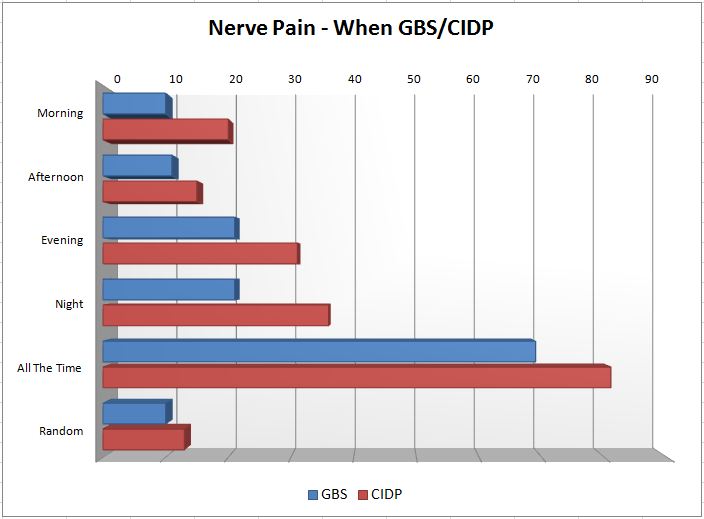
The graph above tries to compare differences between GBS & CIDP. Clearly, though these is an increase in the numbers with nerve pain between GBS & CIDP, the relative numbers are remarkably similar. This would seem to indicate is is consistent across the two conditions, which I find surprising.

Finally, for now, doing the same comparison between genders has the same differences as between the diseases. The only minor difference is in random pain. This is really surprising and must be a coincidence, unless all the males who filled in the survey have GBS & all the females CIDP! (which they do not).
Next time I will review where the nerve pain is....
Sunday, 30 December 2012
Update 22 - Survey Results Part 9
The survey these results are based on is still running and will until the 12th of March 2013. So please can anyone who has GBS/CIDP or related conditions please fill in the survey (if they have not already). It it located at:
The results below are about physical treatments and the spread/symptoms:

These are the main Physical treatments listed. I have taken Exercise Program to include any sort of exercise and Hydrotherapy to include swimming. The two graphs below are for GBS & CIDP:


The wide variation seen in the results above are entirely expected, as in theory GBS is (acute) therefore the majority of people who had this disease have recovered to some degree or another. For CIDP there only one quarter who have no treatments and I would have expected this to be higher. Don't forget this is those who answered this particular question and as the numbers were fairly low in comparison to the total, the others may not have had any, but not stated so.
For my own condition, I am in the CIDP/None camp, this is primarily down to the fact that all I seem capable of is going to work and eating/sleeping, if I try and exert myself anymore then my body just overloads and as I have to earn a wage for my family that is all I can do. I am ever hopeful the situation will improve.....
Regarding the spread of the condition:

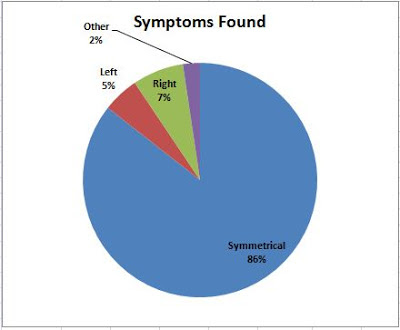
The symptoms are clearly the same for both sides of the body. With no real variation between GBS & CIDP or male & female - this is not surprising. There are not enough answers for me to analyse the results for the other variants.
Next time I will be looking at nerve pains.....
The results below are about physical treatments and the spread/symptoms:

These are the main Physical treatments listed. I have taken Exercise Program to include any sort of exercise and Hydrotherapy to include swimming. The two graphs below are for GBS & CIDP:


The wide variation seen in the results above are entirely expected, as in theory GBS is (acute) therefore the majority of people who had this disease have recovered to some degree or another. For CIDP there only one quarter who have no treatments and I would have expected this to be higher. Don't forget this is those who answered this particular question and as the numbers were fairly low in comparison to the total, the others may not have had any, but not stated so.
For my own condition, I am in the CIDP/None camp, this is primarily down to the fact that all I seem capable of is going to work and eating/sleeping, if I try and exert myself anymore then my body just overloads and as I have to earn a wage for my family that is all I can do. I am ever hopeful the situation will improve.....
Regarding the spread of the condition:

As can be seen the spread is primarily inwards (defined by me as from the extremities into the core, so feet and hands first). There is some minor variation between GBS & CIDP. With GBS having a higher number with inwards (106 to 95) and CIDP having the majority of people who answered Outwards (25 to 12), so two thirds.

The symptoms are clearly the same for both sides of the body. With no real variation between GBS & CIDP or male & female - this is not surprising. There are not enough answers for me to analyse the results for the other variants.
Next time I will be looking at nerve pains.....
Sunday, 9 December 2012
Update 21 - Survey Results Part 8
When I started this survey and analysing the results I never thought I would get this many and this far (in a way I am sorry it has taken so long for me to publish them)!
This section starts with the treatment periods. Below is a comparison graph, between the numbers of treatments being provided for GBS (red) and CIDP (green):

This is a very interesting comparison of how frequent people are being treated. The vast majority of GBS sufferers are either having daily treatment or none, yet for CIDP it is either daily or monthly (which is what you would expect, given the differences between the diseases?). I am presuming that daily are pills (e.g. Steroids) and monthly is Plasma/IVIG.
The Details: 40% of people with GBS have no treatments, yet less than 4% with CIDP do. 41% of GBS have daily treatments and 23% of CIDP. At the other end of the scale; around 10% of those with CIDP have treatments every 2 or 3 weeks, with 33% having treatments every month (or 4 weeks), whereas only 7% of GBS have monthly treatments. The average treatment period for those with GBS is every 4.6 days, yet with CIDP it is 18.6 days.
Below are the graphs on how mobile people are (split into Overall, GBS, CIDP, Male & Female):


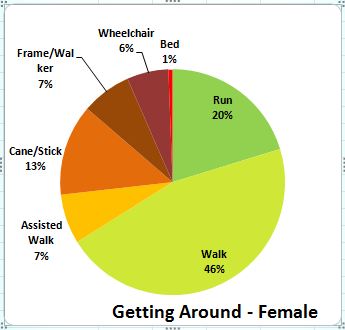

There are some interesting differences between the groups:
- Very few are completely bed bound and none of those with CIDP are.
- 27% of those with GBS and now run and only 15% with CIDP (personally if I had to "run for my life" I'd be dead! - it is not an option)
- 68% of those with GBS can run or walk compared with 59% of CIDP
- 23% of those with CIDP use a cane/stick and only 15% of those with GBS (this must be linked to the previous point from a simple numbers percentage)
- The only point from the male and female statistics is that males use canes/sticks much more (24% to 13%)
Next I reviewed the external care required, see the table below:

What really surprises me is that 80% of people said they needed no external care. Now this may be my fault for the way the question was phrased: "Do you need external care - others to look after you?". I meant this to include any one else, e.g. family as well and due to such a high "No" response, I wonder if some answered in this way. Still it is an excellent and significant number who do not need any assistance from others.
At the other end of the scale only 9% need help for everything, which is also encouraging. Looking across all the categories the numbers are remarkably consistent (and because 80& don't need help, very low).
I added a couple of heading from the Other answers, driving and chores, as they seemed to be worthwhile. I do understand that some people may have overlapped answers/categories and those be covered elsewhere, but that is the problem with any survey/questions (whether verbal, written, web or any other), how do you phrase a question to ensure that all respondents understand exactly what is meant and answer in exactly the same way/terms/scale as everyone else.......
You Can't
Sunday, 25 November 2012
Update 20 - Survey Results Part 7
Minor delay between this and the last one due to a trip to Paris (business). My one observation is that all hotels throughout the world now look the same and I'm sure the air is!
This is the last part of the results around the effects of treatments. I tried to do some analysis based on gender and illness. The tables below show the different results for Males & Females with either GBS or CIDP:


These again show IVIG as being potentially most successful, though Steroids do have a more major impact (especially for Females). It also does seem that Immuno-suppresants are used much more with CIDP, though there success rate is questionable (again higher with Females).
Please note these are statistics produced from the survey and not specific recommendations to any one about treatments. If I could I would love to examine the treatments recommended against location in the countries/world, but I do not have enough data to go on.
This concludes the treatments and their effectiveness based on the 350 completed surveys from August 2012. Next I'll be looking into the treatment periods and how people are coping.
This is the last part of the results around the effects of treatments. I tried to do some analysis based on gender and illness. The tables below show the different results for Males & Females with either GBS or CIDP:


To see these results graphically, I have produced the following charts:
The above charts and the ones for CIDP below are shown as a percentage of the overall people who have recieved these treatments, so the scale is a percentage and not a number. For the specific numbers, please refer to the tables at the top of this section.
What these show, along with the tables, is that the actual treatments with most effect on GBS are IVIG and Plasma. Also the tables show that these are the two most recommended treatments as well. Steroids do seem to have some effect, but less on Males than Females for GBS. Immuno-suppresants appear high in the chart for Females, but this is due to only 3 samples being available, so this is too few to draw a reasonable conclusion from (in my opinion).
These again show IVIG as being potentially most successful, though Steroids do have a more major impact (especially for Females). It also does seem that Immuno-suppresants are used much more with CIDP, though there success rate is questionable (again higher with Females).
Please note these are statistics produced from the survey and not specific recommendations to any one about treatments. If I could I would love to examine the treatments recommended against location in the countries/world, but I do not have enough data to go on.
This concludes the treatments and their effectiveness based on the 350 completed surveys from August 2012. Next I'll be looking into the treatment periods and how people are coping.
Saturday, 3 November 2012
Update 19 - Survey Results Part 6
The next set are concerned with differences between female and male treatments/effects:


As you can see, and has been the case throughout the effectiveness of treatments across all segments, IVIG has a significant impact on both males and females. However it does seem to have a better major effect on females (10% difference), whereas males are higher in the minor/none categories?


The graphs above show a similar ratio of the types of treatments, though as slightly more females have filled in the survey there are more results for them (281 against 265). What is interesting is that the number of other treatments and their effect on females is much higher than males. The actual treatments recommended, percentage wise, didn't vary much at all between the two for the normal ones.
Below are the effectiveness charts for each treatment against males and females:
Steroids seem to follow a similar pattern to IVIG, however though the Major effectiveness has a 5% difference, the some is much higher with females (14%), thus the minor/none are much higher. This does seem to indicate (even more than with IVIG) that there is a significantly better effect of steroids for females.
There is definitely a pattern forming with the males having Plasma being improved way less than females, what is most interesting here is the difference between the none's (18%). That in my view is massive.
This one is even worse than the other three, with females having a much more positive reaction to this treatment than males, there is 20% difference between the major effectiveness.
Please note the actual numbers of people having the last two treatments is much lower than for IVIG and Steroids, so this may be impacting the figures slightly. However it can't be disputed that there is a pattern of better reaction to treatments in general from the females than the males. Now work that one out?
Subscribe to:
Posts (Atom)