Saturday, 2 March 2013

Update 26 - Survey Conclusions

My survey into GBS & CIDP will stop running in 1 week (on the 10th of March 2013). Please can anyone with GBS/CIDP who reads this and hasn't filled it in, do so. I have around 500 completed results and would like as many more as possible.  The link is:


http://gbs-cidp.questionpro.com

Conclusions

As I am not a medical person and the sole "experience" of GBS/CIDP is based on what has happened to me. What I conclude below is based purely on how people have responded to my survey and the feedback I have been given to the results:

  1. The age range of people contracting GBS/CIDP is around 35 to 64 - which is lower than generally assumed (this could be countered by the fact that younger people use computers therefore are more likely to fill in something on-line)
  2. The actual fitness levels of the people who get GBS/CIDP have nearly 90% as active or fairly active. Is this because they have more active immune systems? or because they travel more and expose themselves to more hostile/less sterile environments? or have more injections.....
  3. It is definitely the extremities that are mostly affected, with the feet being slightly ahead of the hands.  However CIDP has a higher affected area all over the body than GBS (more areas affected by around 20%)
  4. IVIG is the most proscribed treatment and seems to have a reasonable success rate, plasma is an alternative in some countries and steroids are more effective against CIDP than GBS, but all treatments have a fair degree of uncertainty about whether they will work at all and there is no miracle cure!
  5. Men seem to complain less than women (that is a generalism about illness and going to doctors anyway).  However women seem to get on with things and cope with pain better!
  6. A high number of people with GBS are still stating they have after effects/major issues.  The areas this has shown up in are getting around, nerve pain, how healthy are they now and ability to work.  So if GBS is acute and a one hit illness, people should be able to return to a reasonably normal life afterwards?  It is commonly stated that 80% of people make a full recovery from GBS and 20% from CIDP.  Whilst the results certainly back up the latter, there seems to be a lot less people making anywhere near a full recovery from GBS and as for being acute (it is certainly not "a cute" condition!), a significant number appear to be having long term residual effects. I would suggest that the boundaries and differentials put in place between GBS & CIDP need re-examining and that the leas than 4 weeks - GBS; over 8 weeks - CIDP is not as accurate as the medical people think and there is always the people in between......
The final conclusion is that there needs to be more research and understanding, however, I hope, at least more is known from a patients eye view now than before.

Presentation

The GBS Support Group in the UK have an annual meeting, this time near Liverpool on the 20th of April 2013.  I have been given a 20 minute slot to present some of the results from my survey (as I don't have time to do them all) and then answer questions.  The presentation will be based on the final survey number, around 500.  I will happily send the final version to anyone (after the 20th of April) who may want a copy, so please email or facebook me.

I hope the presentation will be illuminating & interesting and I will represent the findings in a fair and accurate manner.  I will also put in a number of the conclusions from above and try and get the opinions of the medical people at the meeting to my results.

Thank You

I would like to say a great big thank you to all the people who filled in my survey and have made it into the successful venture it has become. When I started out on this I had no idea how it would be received and what would come out. I wish I had phrased some of the questions better and maybe asked others, but I hope that publishing real information based on our experiences, this has assisted people in understanding how others are affected and provided some insights into the nature of GBS/CIDP. 

It was a shame that, apart from minor curiosity from certain medical people and individual support from one or two sections of the GBS/CIDP community, not one of the formal groups actually assisted me in any way or even sanctioned that what I was doing. Yet thanks for your efforts and support.

Now all I have to do is publish the results to the web for the 500!.....


Saturday, 23 February 2013

Update 25 - Survey Results Part 12

This is the last part of the original survey, based on the 300 from August 2012:

I asked about the ability of people to return to work:


 To my untrained eye this looked a bit wrong, so separating GBS & CIDP you get:


Now this really did not make sense.  If GBS is an acute condition and 80% of people with it make a good recovery, then I would expect 80% of those to be back at work (so I expected a 20% - No, 20% - Limited and 60% - Fully), whereas for GBS we have a 50/50 split.  So, whilst I am happy with the CIDP figures, the GBS ones seem to be far too high, is it because:

  • I asked the question in the wrong way? "Are you able to return to work? (Yes - Fully, Yes - Limited or No)"
  • Are people being mis-diagnosed with GBS when they have CIDP (because GBS is more known about?)
  • Does it relate to previous slides about fatigue and this causes them not to be able to return to work
  • Are the previous thoughts on this for GBS wrong
  • Should other factors be considered:
    • like people are older and recover less fast
    • were much fitter before so will struggle afterwards
    • generally in the before and after they can do less
  • Is GBS not an acute condition!

I do not know the answer. From my position, with CIDP, I have returned to work fully (with modifications to my car and job), but I suffer massively from fatigue and can (and have) over do it and cause issues, but as I need to earn money, I have little choice.

Looking at how healthy people now are, we get:


What we can clearly see is that GBS sufferers are much more healthy than those with CIDP, as stated before this is entirely expected. Once again though, I would have presumed the numbers for GBS would be substantially higher?

The final chart shows this direct comparison off better:


So people with GBS are healthier than people with CIDP, but the difference from the people who filled in my survey is not that distinct.

These are my last charts.  On my next submission I will try and draw some conclusions, then I have to re-incorporate the 500 results (ish) I now have and work out how to display the results in an easier form for you to digest (and one that won't take me 6 months to publish!).

Saturday, 9 February 2013

Update 24 - Survey Results Part 11

This is the penultimate set of results of my survey (based on the 300 completed originally).  These are about where nerve pain is and how tired people get:


This graph tends to follow the trend of all the other "feelings" charts, whereby the extremities are most affected with the feet/toes being marginally ahead of the hands and fingers.  I presume the toes are slightly less than the feet because, unlike the fingers which are the most used parts of the body, the toes are not used - well that certainly applies to me (no pencil picking up ever again!).  We all know immediately if our fingers have issues.


By comparing GBS & CIDP the relationships between the areas is more or less the same, but the numbers are higher with CIDP, which is to be expected, as people (me included) still get pain.


Comparing men and women, as with other charts, seems to bear out the theory that men complain less?  Though why is it the one area that men complained more was around the stomach?? (must be to do with food!)

This next part is concerned with how tired people get:


As you can see the vast majority do!  From a statistical viewpoint, noting the age of the people filling in the survey, would they not be getting more tired anyway? Maybe I should look into this more closely??

From a GBS versus CIDP viewpoint:


It is clear there is a difference and as a person with CIDP, I can agree that I am exhausted at the end of each and every day - and really don't know where the energy has gone - when comparing myself to before the illness .

My follow on question to the GBS sufferers (and I suppose to CIDP as well) is "Is the pain and tiredness still there?"

Saturday, 19 January 2013

Update 23 - Survey Results Part 10

This part starts looking at nerve pain.  The following graphs are for whether people have nerve pain and whether they regard it as mild or severe.


 The overall graph look quite balanced between the three categories, with Mild being the highest (marginally).


When you start looking at the differences between GBS & CIDP, they are significant.  With Severe increasing and None decreasing.  It is interesting that Mild stays more or less the same.


When you get to the differences between gender, they are also significant.  With exactly the same trending as with GBS/CIDP, with females suffering from considerably more pain than males! Maybe men are hardier after all?

I am aware of the issues with self diagnosis of how each person regards a level of pain/discomfort.  My view is that this is usually based on a previous reference point, thus if you have had severe pain in the past, you can gauge what you have for GBS/CIDP against that and it doesn't seem so bad.  This is certainly the case for me, as I have had a severely broken leg (when I was 9) and can remember the initial pain from that as being excruciating, so when comparing my nerve pains today with that I would rate this at around 6 or 7 (as simply I can put up with it, whereas before I could not).

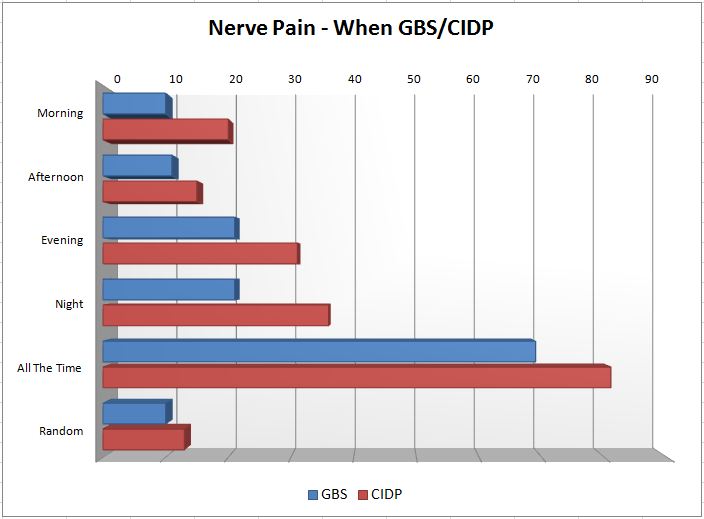
If I look at the answer to "When do you have pain?":


This to me looks curious and worthy of more inspection, as 45% of people who get nerve pain get it all the time, yet between the other categories it is fairly similar, though evening/night have higher numbers.  I would have expected to see patterns around wither lots of activity or none (e.g. night) - which in my case is when I get the vast majority of my issues (especially at 2:00 in the morning).  Maybe we are less active in both the evening and night....


The graph above tries to compare differences between GBS & CIDP. Clearly, though these is an increase in the numbers with nerve pain between GBS & CIDP, the relative numbers are remarkably similar.  This would seem to indicate is is consistent across the two conditions, which I find surprising.


Finally, for now, doing the same comparison between genders has the same differences as between the diseases.  The only minor difference is in random pain.  This is really surprising and must be a coincidence, unless all the males who filled in the survey have GBS & all the females CIDP! (which they do not).

Next time I will review where the nerve pain is....


Sunday, 30 December 2012

Update 22 - Survey Results Part 9

The survey these results are based on is still running and will until the 12th of March 2013.  So please can anyone who has GBS/CIDP or related conditions please fill in the survey (if they have not already).  It it located at:


The results below are about physical treatments and the spread/symptoms:


These are the main Physical treatments listed. I have taken Exercise Program to include any sort of exercise and Hydrotherapy to include swimming.  The two graphs below are for GBS & CIDP:


The wide variation seen in the results above are entirely expected, as in theory GBS is (acute) therefore the majority of people who had this disease have recovered to some degree or another.  For CIDP there only one quarter who have no treatments and I would have expected this to be higher. Don't forget this is those who answered this particular question and as the numbers were fairly low in comparison to the total, the others may not have had any, but not stated so.

For my own condition, I am in the CIDP/None camp, this is primarily down to the fact that all I seem capable of is going to work and eating/sleeping, if I try and exert myself anymore then my body just overloads and as I have to earn a wage for my family that is all I can do.  I am ever hopeful the situation will improve.....

Regarding the spread of the condition:


As can be seen the spread is primarily inwards (defined by me as from the extremities into the core, so feet and hands first).  There is some minor variation between GBS & CIDP.  With GBS having a higher number with inwards (106 to 95) and CIDP having the majority of people who answered Outwards (25 to 12), so two thirds.


The symptoms are clearly the same for both sides of the body. With no real variation between GBS & CIDP or male & female - this is not surprising.  There are not enough answers for me to analyse the results for the other variants.

Next time I will be looking at nerve pains.....

Sunday, 9 December 2012

Update 21 - Survey Results Part 8

When I started this survey and analysing the results I never thought I would get this many and this far (in a way I am sorry it has taken so long for me to publish them)!

This section starts with the treatment periods.  Below is a comparison graph, between the numbers of treatments being provided for GBS (red) and CIDP (green):


This is a very interesting comparison of how frequent people are being treated.  The vast majority of GBS sufferers are either having daily treatment or none, yet for CIDP it is either daily or monthly (which is what you would expect, given the differences between the diseases?).  I am presuming that daily are pills (e.g. Steroids) and monthly is Plasma/IVIG.

The Details:  40% of people with GBS have no treatments, yet less than 4% with CIDP do.  41% of GBS have daily treatments and 23% of CIDP.  At the other end of the scale; around 10% of those with CIDP have treatments every 2 or 3 weeks, with 33% having treatments every month (or 4 weeks), whereas only 7% of GBS have monthly treatments. The average treatment period for those with GBS is every 4.6 days, yet with CIDP it is 18.6 days.

 The differences between males and females is either pretty minor with males having more daily treatments (37 to 24) and females having more 3 weekly and monthly (39 to 29).

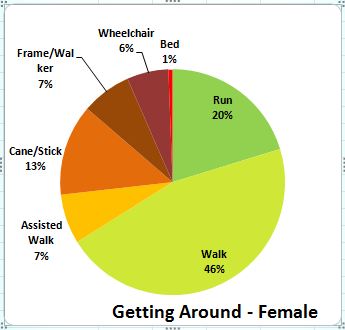
Below are the graphs on how mobile people are (split into Overall, GBS, CIDP, Male & Female):


There are some interesting differences between the groups:
  • Very few are completely bed bound and none of those with CIDP are.
  • 27% of those with GBS and now run and only 15% with CIDP (personally if I had to "run for my life" I'd be dead! - it is not an option)
  • 68% of those with GBS can run or walk compared with 59% of CIDP
  • 23% of those with CIDP use a cane/stick and only 15% of those with GBS (this must be linked to the previous point from a simple numbers percentage)
  • The only point from the male and female statistics is that males use canes/sticks much more (24% to 13%) 

Next I reviewed the external care required, see the table below:


What really surprises me is that 80% of people said they needed no external care.  Now this may be my fault for the way the question was phrased: "Do you need external care - others to look after you?".  I meant this to include any one else, e.g. family as well and due to such a high "No" response, I wonder if some answered in this way.  Still it is an excellent and significant number who do not need any assistance from others.

At the other end of the scale only 9% need help for everything, which is also encouraging.  Looking across all the categories the numbers are remarkably consistent (and because 80& don't need help, very low).  

I added a couple of heading from the Other answers, driving and chores, as they seemed to be worthwhile.  I do understand that some people may have overlapped answers/categories and those be covered elsewhere, but that is the problem with any survey/questions (whether verbal, written, web or any other), how do you phrase a question to ensure that all respondents understand exactly what is meant and answer in exactly the same way/terms/scale as everyone else.......

You Can't


Sunday, 25 November 2012

Update 20 - Survey Results Part 7

Minor delay between this and the last one due to a trip to Paris (business).  My one observation is that all hotels throughout the world now look the same and I'm sure the air is!

This is the last part of the results around the effects of treatments.  I tried to do some analysis based on gender and illness.  The tables below show the different results for Males & Females with either GBS or CIDP:


To see these results graphically, I have produced the following charts:


The above charts and the ones for CIDP below are shown as a percentage of the overall people who have recieved these treatments, so the scale is a percentage and not a number.  For the specific numbers, please refer to the tables at the top of this section.

What these show, along with the tables, is that the actual treatments with most effect on GBS are IVIG and Plasma.  Also the tables show that these are the two most recommended treatments as well.  Steroids do seem to have some effect, but less on Males than Females for GBS.  Immuno-suppresants appear high in the chart for Females, but this is due to only 3 samples being available, so this is too few to draw a reasonable conclusion from (in my opinion).


These again show IVIG as being potentially most successful, though Steroids do have a more major impact (especially for Females).  It also does seem that Immuno-suppresants are used much more with CIDP, though there success rate is questionable (again higher with Females).

Please note these are statistics produced from the survey and not specific recommendations to any one about treatments.  If I could I would love to examine the treatments recommended against location in the countries/world, but I do not have enough data to go on.

This concludes the treatments and their effectiveness based on the 350 completed surveys from August 2012. Next I'll be looking into the treatment periods and how people are coping.


Saturday, 3 November 2012

Update 19 - Survey Results Part 6

The next set are concerned with differences between female and male treatments/effects:


The graphs above show a similar ratio of the types of treatments, though as slightly more females have filled in the survey there are more results for them (281 against 265).  What is interesting is that the number of other treatments and their effect on females is much higher than males.  The actual treatments recommended, percentage wise, didn't vary much at all between the two for the normal ones.

Below are the effectiveness charts for each treatment against males and females:


 As you can see, and has been the case throughout the effectiveness of treatments across all segments, IVIG has a significant impact on both males and females.  However it does seem to have a better major effect on females (10% difference), whereas males are higher in the minor/none categories?


Steroids seem to follow a similar pattern to IVIG, however though the Major effectiveness has a 5% difference, the some is much higher with females (14%), thus the minor/none are much higher.  This does seem to indicate (even more than with IVIG) that there is a significantly better effect of steroids for females.


There is definitely a pattern forming with the males having Plasma being improved way less than females, what is most interesting here is the difference between the none's (18%).  That in my view is massive.


This one is even worse than the other three, with females having a much more positive reaction to this treatment than males, there is 20% difference between the major effectiveness.

Please note the actual numbers of people having the last two treatments is much lower than for IVIG and Steroids, so this may be impacting the figures slightly.  However it can't be disputed that there is a pattern of better reaction to treatments in general from the females than the males.  Now work that one out?

Saturday, 20 October 2012

Update 18 - Survey Results Part 5

This is a very long posting, but hopefully the information on the comparison between GBS and CIDP for each treatment is worth it. The first two graphs are on the effect of treatments:


It is clear that IVIG is by far the most recommended treatment for either condition (118 for GBS & 143 for CIDP).  Yet Steroids are recommended much more for CIDP & Plasma for GBS.  The percent details for each are shown below:


The above do show the difference in the treatments more clearly than the first graphs.

Below are graphs for the effectiveness of each treatment:


These again show the definite leaning towards IVIG as the recommended treatment and how much more steroids are used for CIDP.  The point of showing the information is this way is that the actual numbers for certain treatments (e.g. GBS & Steroids - 20 & Immuno-suppressants - 10) is very low so the following pie charts may be skewed and not properly representative:

This chart shows that IVIG clearly has a significant benefit to the majority of people with GBS.  So it is not surprising that this is the most recommended treatment too.

Steroids do have some benefit, but the ration of major to none is very similar and the sample size is small, so can be affected by a few results.

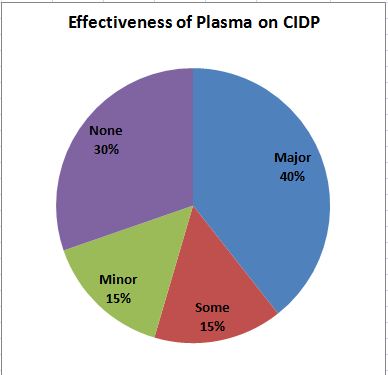
Plasma has a slightly better success rate than IVIG, but I understand it is more expensive and difficult to administer (please note as I never had or was offered this treatment I do not know, so apologies if I have got this wrong).  It is clear that this is a good treatment against GBS.


Immuno-Suppressants have some effect, but as the sample size is small, this really has been impacted by one or two results.

Now we move onto the same chats for CIDP:

Again IVIG has a significant effect on CIDP as with GBS, with almost exactly the same percentage scores (spooky!).  This is proof why it is the most recommended and used treatment.

Steroids have a pretty good effect on CIDP, much better than for GBS, but there are still a significant number of people it has no effect on.

Plasma is much less effective against CIDP than GBS, but it obviously still works for a fair number of people (18 out of 33, just over half).

Immuno-suppressants again have much less effect against CIDP than GBS. though the number it is proscribed for are much higher for CIDP (47) against GBS (10)?

Obviously before deciding on a treatment other factors have to be taken into consideration e.g. potential side effects, ease of administering or availability of the treatments, other health issues..... Which I have not explored and these may have a significant bearing on the results/recommendations above.

From the above data it is easy to see patterns.  What I wonder about is why certain treatments do not work for some patients?  I guess we will never know..... or not from me!  More in a couple of weeks.